SA100 Specifications
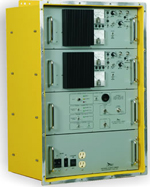
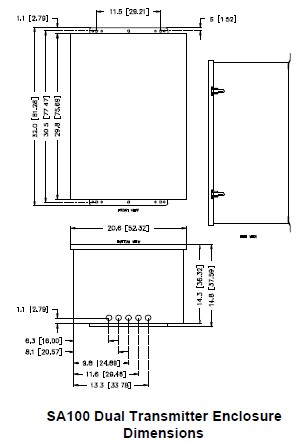
Qualifications: Meets applicable requirements of ICAO,
FCC, and FAA.
Frequency Range: 190-535 kHz, (optionally 190 to 625
kHz) or (250 to 1250 kHz for offshore installation using the
222 whip antenna), crystal controlled synthesizer, switch
selectable in 500 Hz increments, stability better than
.005% (-40°C to +70°C).
Power Output: Carrier power into 50 ohms
continuously adjustable 25 to 100 watts, (100-400 W
PEP).
Spurious Emission: Radiated harmonics (measured at
a dummy antenna) are better than 63 dB below the 100
watt carrier.
Type of Emission: NON, A2A, A3E (Optional), GID
(with optional GPS beacon modulator, or any combination.
Modulation: Switching modulator/regulator provides high
level modulation 0-95 percent. Internal 400 Hz and 1020
Hz tone is selectable. Internal keyer normally operates at
eight baud (approximately 7 WPM) and is adjustable from
5 to 16 baud. In normal operation, carrier is on
continuously with keyed tone modulation.
Noise and Hum Level: Better than 40 dB below the
carrier level.
Input Power: 115/230V ±15%, single phase 50-60 Hz.
24 VDC. Nominal input power is 180W at 100W carrier
and tone keying at 95% modulation.
Metering: Power output, reflected power, PA voltage,
PA current, percent modulation, audio input level.
Keyer: The solid state keyer provides 95 DIP switch
programmable dot spaces. A dot space is adjustable
from 63 to 166 ms. Special coding is available.
Circuit Protection: Individual fuses are used to protect
the AC and DC circuits. VSWR circuit that shuts down
the transmitter if VSWR exceeds an adjustable value.
Working Conditions: Continuous unattended operation
in the following environments: ambient temperature, -50°C
to +70°C; relative humidity, 0-100% noncondensing; high
salinity as encountered in offshore conditions.
Monitoring: Transmitter shuts down with loss of tone,
drop in modulation below an adjustable value, or
continuous tone, or when power falls below an adjustable
value, or when VSWR rises above an adjustable value.
With a dual system, a shutdown signal initiates a transfer
from the primary transmitter to the secondary transmitter.
|